
Macro · China
A Fiscal Policy Brief on China's 2026 Economy

Executive Summary
This brief evaluates the current macroeconomic position of China using macroeconomic indicators and models to deliver a clear fiscal policy recommendation.
China is at a late expansionary stage with clear signs of deceleration. Real GDP growth of 4.5% is well below the historical average of 8–9%. Unemployment sits exactly at the natural rate (5.1%), inflation hovers near zero (0.8%) with real deflation risk, and consumer confidence is at historic lows due to a damaged property sector. Without action, Aggregate Demand will shift leftward, leading to the opening of a recessionary gap. This brief recommends expansionary fiscal policy: increased government spending and targeted tax cuts to shift AD rightward, stabilise growth at ~5.5–6%, and anchor inflation at 2%.
Methodology
Analysed real/nominal GDP, unemployment, inflation, interest rates, market performance, and consumer data (Q4 2025–Q1 2026), applying AD-AS modelling, Phillips Curve analysis, and fiscal multiplier theory. It also takes into consideration social and cultural factors that may potentially influence economic growth and reactions.
I. The Diagnosis
The Big Three Indicators
1. GDP. Real GDP grew 4.5% year-over-year in Q4 2025. Although this seems like substantial growth to some countries, China historically averaged 8–9%, meaning the economy is showing signs of slowing down, which is not ideal. Nominal GDP stands at ¥134.91 trillion (~$18.7 trillion USD): the economy is large, but the growth rate signals deceleration in the Chinese context.
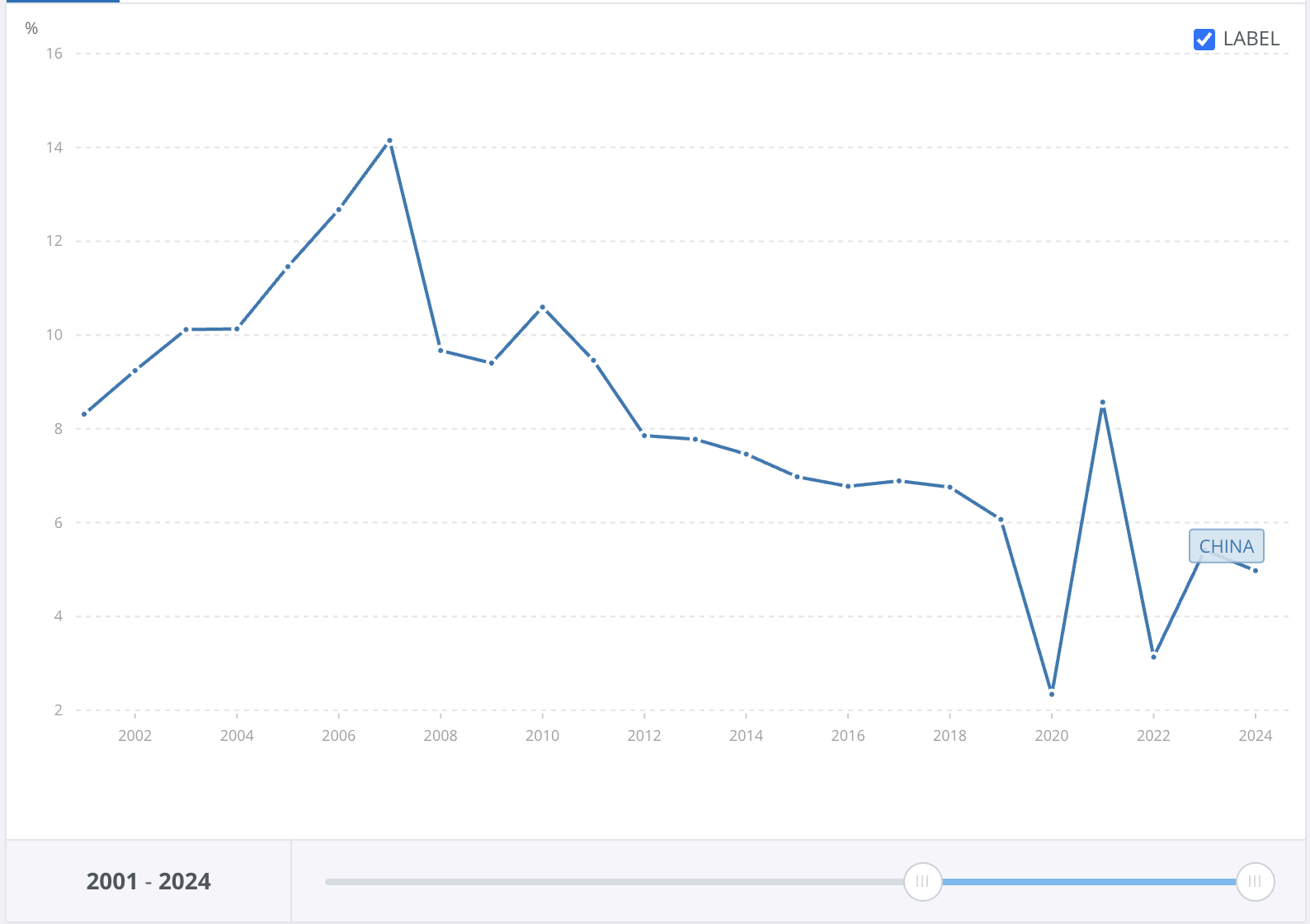
2. Unemployment: 5.1% (December 2025), exactly at the Natural Rate of Unemployment (NRU: 5.1–5.2%). There is no cyclical unemployment today, but looking at this through the lens of Chinese society, we can see problems that still need to be addressed. Youth unemployment, gig economy displacement, and tech-driven job loss are hidden pressures.
3. Inflation: ~0.8%, dangerously near zero. Manageable when slightly low, but if it drops into deflation the economy's circulation breaks down. Consumers delay purchases, firms cut investment, and debt burdens rise in real terms.
Other Key Indicators
Consumer confidence sits near historic lows (late 2025/early 2026), driven by the property market collapse, employment concerns, and weak income growth. Market performance offers a rare tailwind: the Shanghai 50 reached 3,083 in January 2026, its highest level since June 2022, suggesting investor confidence in China's long-run industrial dominance despite short-run demand weakness. The Loan Prime Rate stands at ~3% (1-year) and ~3.5% (5-year), showing the People's Bank of China is already easing monetary policy. Meanwhile, urban wage growth has slowed significantly and hiring is at recent lows.
China's Biggest Macroeconomic Challenge
China's most urgent challenge is weak domestic demand rooted in a structurally broken property sector and historically depressed consumer confidence. Real estate once drove ~25–30% of China's GDP. With falling house prices eroding household wealth, precautionary saving is crowding out consumption. This is not a cyclical dip but a structural gap that needs active fiscal intervention.
Costs of Economic Imbalance
Deflation risk (inflation too low): if inflation falls below 0%, consumers delay purchases — why buy today if it is cheaper tomorrow? — firms cut investment, and real debt burdens grow. Japan's 'Lost Decade' of stagnation is the defining cautionary tale.
High unemployment (>7–8%): erodes human capital as skills atrophy during joblessness and triggers social instability. Okun's Law estimates roughly a 2% GDP loss per 1% rise in unemployment — an enormous cost China cannot afford with its demographic pressures.
Too-low unemployment (<4.5%): creates wage-price spirals, where labour shortages bid up wages, firms raise prices, and workers demand higher wages. The Phillips Curve bends sharply upward, and overheating destroys the stability China needs for its economy.
Questions for Further Investigation
Q1: If consumer confidence remains depressed for three to five more years, at what point does precautionary saving become permanently embedded in Chinese household behaviour — and can the government shift to consumption-led growth before the demographic window closes?
Q2: As U.S.–China economic decoupling accelerates and export channels narrow, how much additional domestic demand must fiscal policy generate to maintain the government's 5% growth floor, and is that level of stimulus fiscally sustainable long-term?
II. The Models
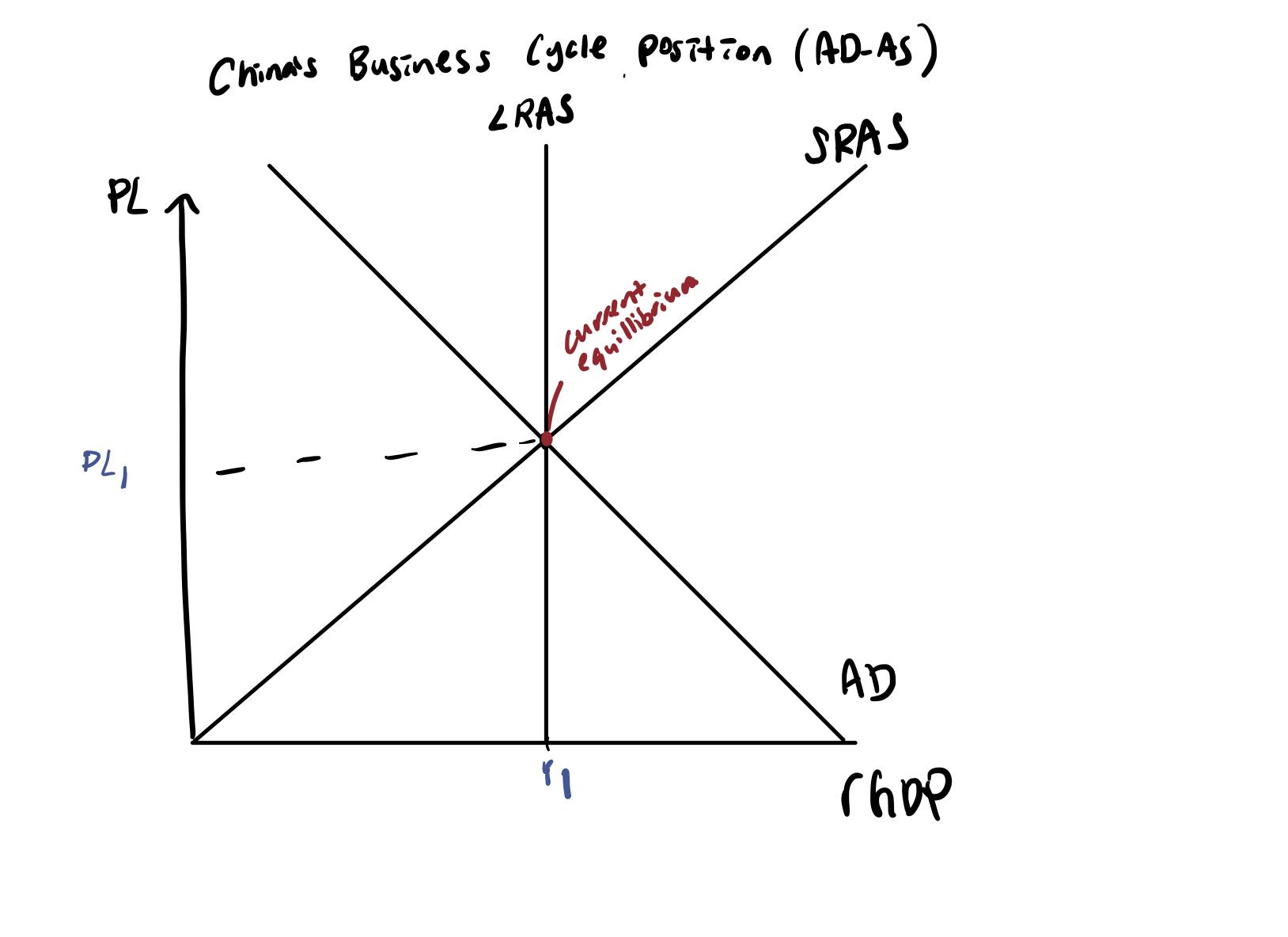
AD (downward sloping) is total spending in the economy (C+I+G+NX); SRAS (upward) is short-run firm supply; LRAS (vertical) is potential GDP, the economy's maximum sustainable output. Currently AD, SRAS and LRAS intersect at the same point: China is at potential output (rGDP₁, PL₁) with no gap yet. But AD risks shifting left as consumer confidence deteriorates, which would open a recessionary gap.
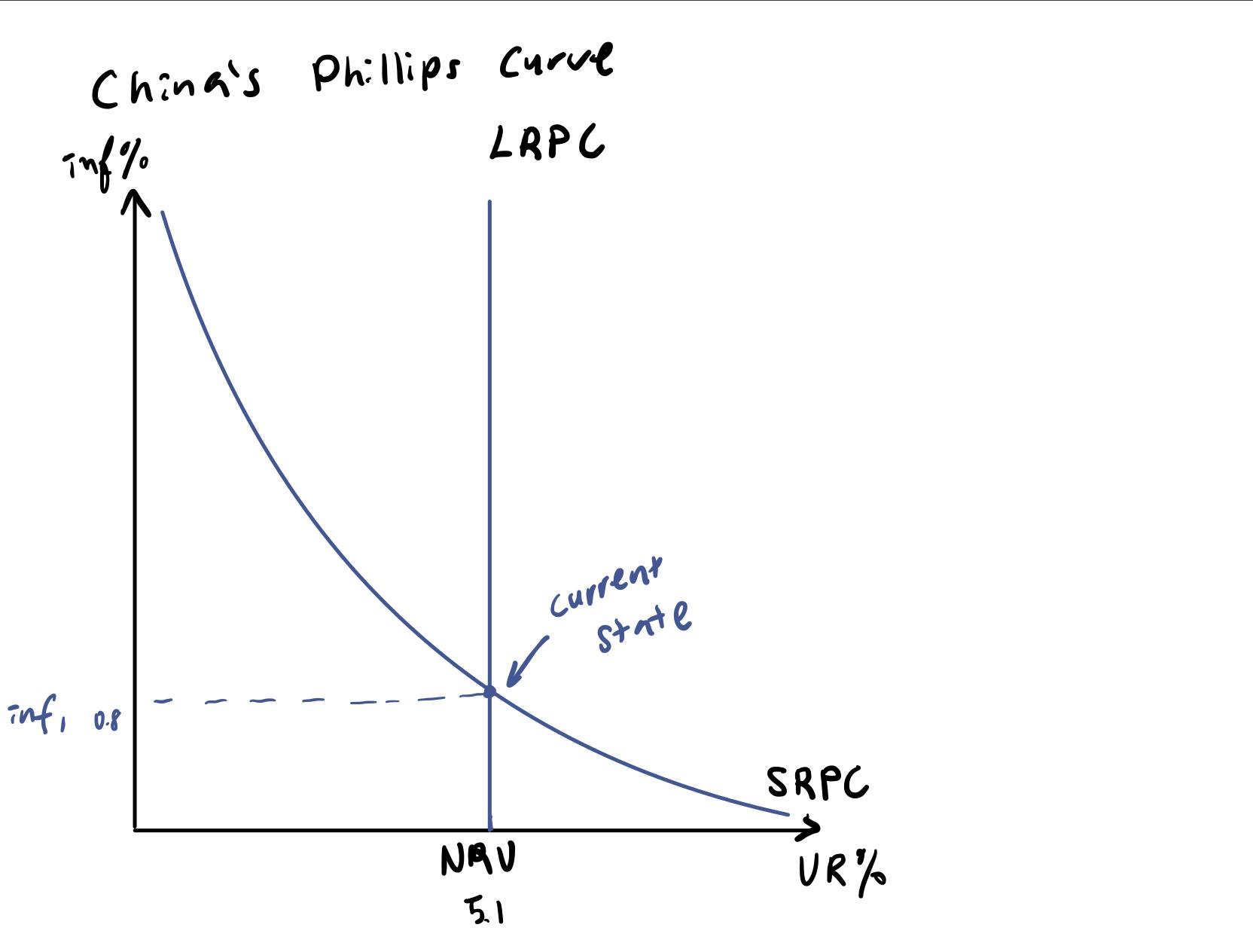
The SRPC (downward sloping) shows the inverse trade-off between unemployment and inflation; the LRPC (vertical at NRU) shows that in the long run no permanent trade-off exists, as the economy self-corrects. China currently sits on the SRPC at NRU = 5.1% with inflation at ~0.8% (January 2026), precariously close to the deflation zone. A leftward AD shift pushes unemployment above NRU and drags inflation negative.
III. Fiscal Policy Recommendations
Expansionary fiscal policy: increase government spending and introduce targeted tax cuts for lower and middle earners.
The multiplier effect: when the government spends ¥1, that becomes income for someone who spends most of it, which becomes income for someone else — rippling through the economy like a stone dropped in a pond. With MPC = 0.75 (households spend 75 fen of every new ¥1) and MPS = 0.25, the spending multiplier is 1 ÷ (1 − 0.75) = 4, so every ¥1T in spending delivers ¥4T of GDP impact. The tax multiplier is −0.75 ÷ 0.25 = −3, so every ¥1T tax cut delivers ¥3T of GDP impact — weaker than spending because some income leaks into savings rather than flowing directly into the economy.
Recommendation 1: ¥2T Government Spending
Where: affordable housing reconstruction, rural broadband infrastructure, and sustainable energy projects. These directly address the property sector collapse and create employment in affected communities. Impact: ¥2T × 4 = ¥8T additional real GDP. This restores jobs, stabilises housing values, and signals government commitment — organically rebuilding consumer confidence.
Recommendation 2: ¥1T Targeted Tax Cuts
Who: lower and middle-income earners. China's tax structure currently favours higher earners who have a lower MPC because they save more; targeting lower earners maximises the multiplier effect. Impact: ¥1T × 3 = ¥3T additional real GDP. Combined total: ¥2T + ¥1T of outlay generates roughly ¥11T in total GDP stimulus.
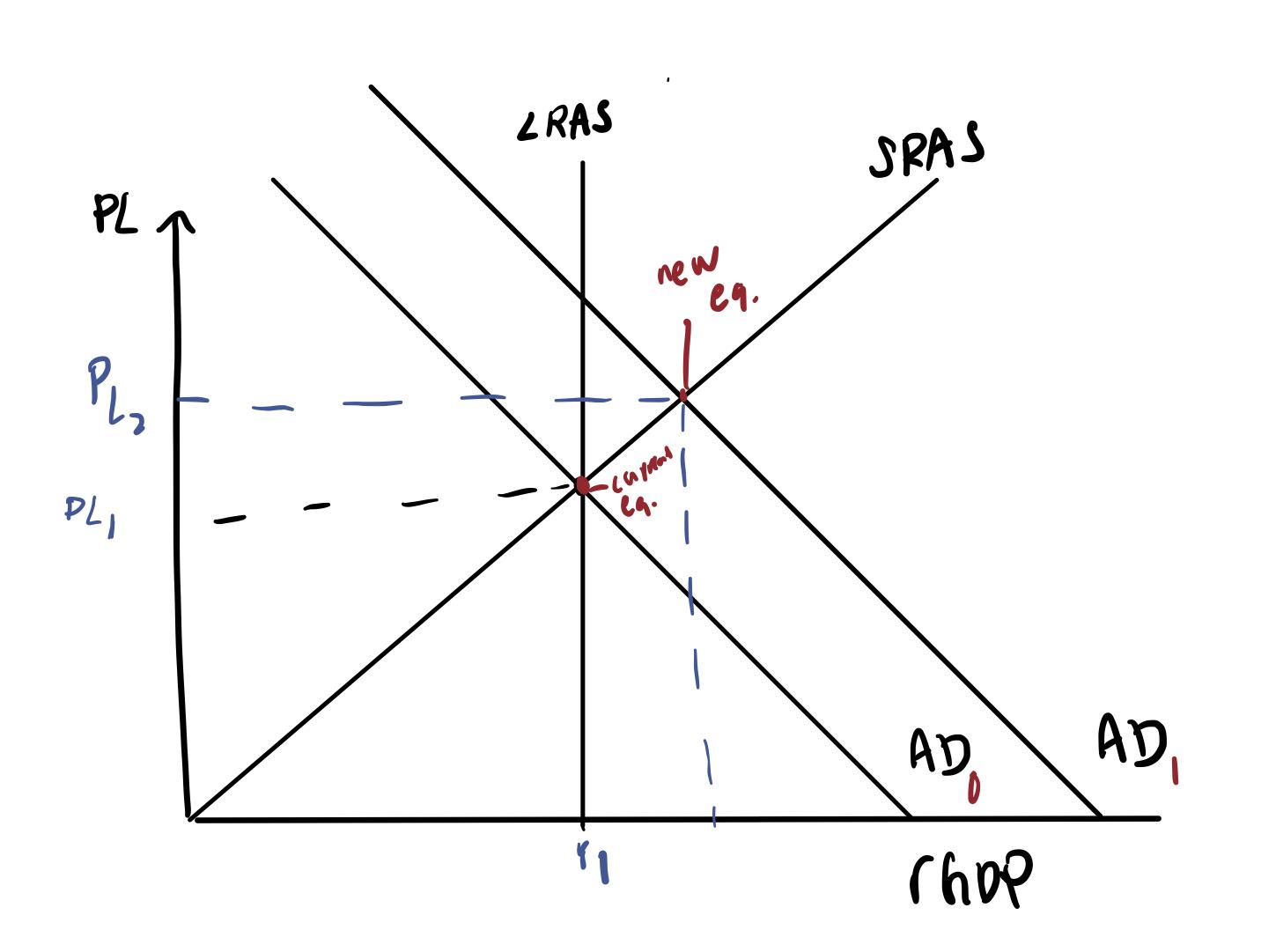
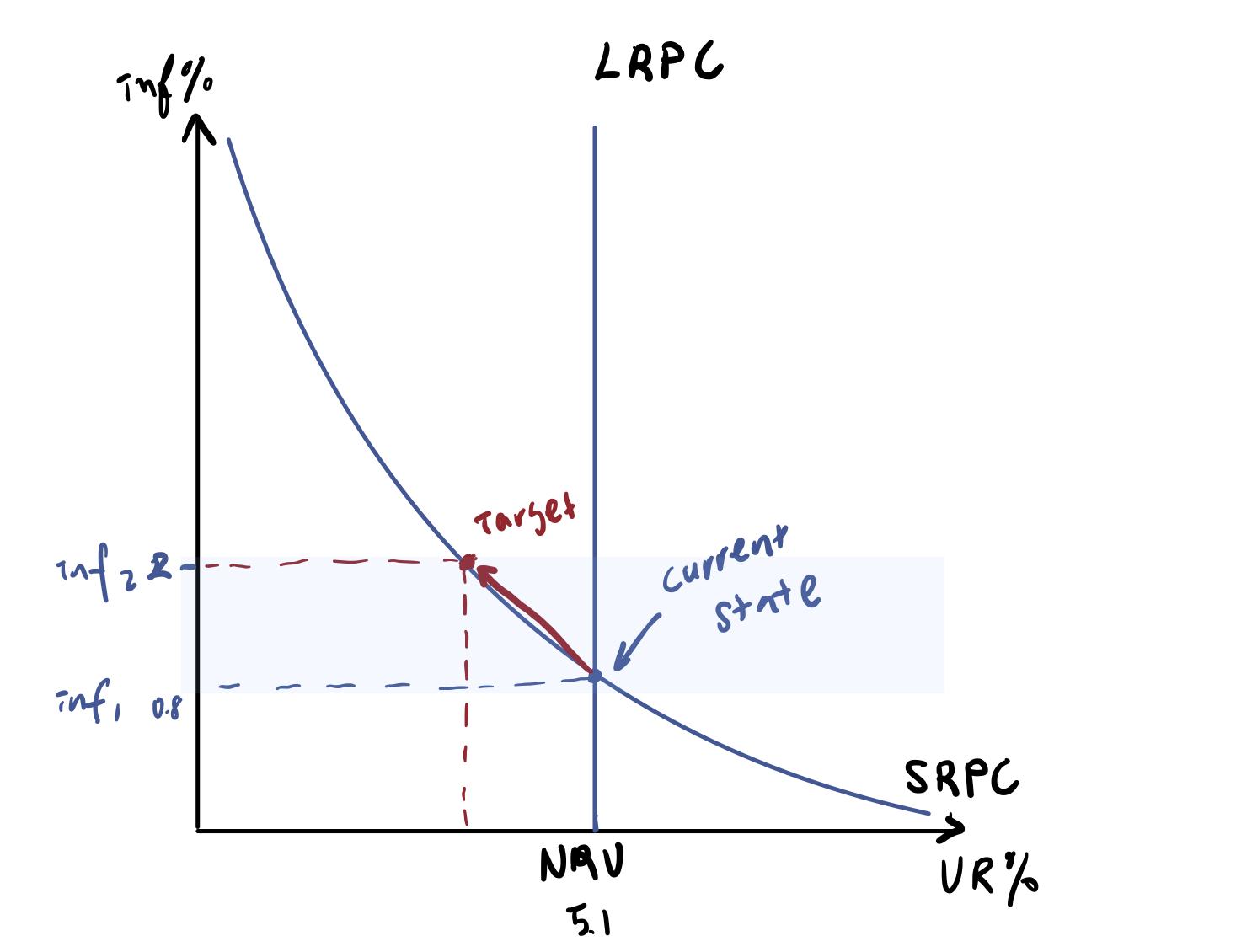
As AD rises, unemployment dips slightly below NRU (5.1% → ~4.8%) and inflation climbs from 0.8% toward 2%. We move along the SRPC upward-left into the target zone, away from deflation.
IV. Trade-offs
Crowding Out (Financial Risk)
Government borrowing competes with private firms for loans, interest rates rise, and private investment falls — the government 'crowds out' the private sector. China's total public debt-to-GDP ratio, including local government financing vehicles, is estimated at 80–110%, making this risk more pressing than headline figures suggest. Sustained deficits could raise borrowing costs, strain already-indebted local governments, and squeeze private investment in tech and manufacturing, the sectors driving future growth in China. Stimulus must therefore be targeted and time-limited.
Inflation Overshoot (Phillips Curve Risk)
If stimulus runs too long, pushing unemployment below NRU toward 4% risks a wage-price spiral: wages rise, firms raise prices, workers demand higher wages, and the SRPC shifts rightward permanently. The result is a worse long-run trade-off requiring contractionary policy to correct.
Conclusion
China stands at an economic inflexion point. After decades of rapid expansion that reshaped cities and lifted hundreds of millions out of poverty, the question is no longer simply how fast China can grow, but what kind of growth will sustain social stability, public confidence, and long-term national resilience. Right now, growth is slowing, deflation threatens, and the property sector is structurally damaged. The data and models show an economy at potential but at serious risk of a recessionary gap.
The recommended strategy — ¥2T infrastructure spending (×4 = ¥8T) plus ¥1T targeted tax cuts (×3 = ¥3T) — generates roughly ¥11T in stimulus, shifts AD right, targets 5.5–6% growth and 2% inflation, and begins rebuilding consumer confidence.
Economic policy at this moment is therefore also social policy. Acting decisively now is about preventing long-term scarring: in employment, in expectations, and in institutional credibility.
References
Bao, Anniek. 2026. "China Keeps Benchmark Lending Rates Unchanged despite Slowing Economic Growth." CNBC, January 20, 2026. · "China's Economy Is Expected to Grow 4.8% in 2026 Amid Surging Exports." Goldman Sachs, January 8, 2026. · CIA World Factbook. · "GDP Growth (Annual %) — China." World Bank Open Data, accessed March 4, 2026.
Contribute
Have research of your own?
Submit your essay to the Metisync desk — selected work is published here with full attribution.
Continue reading



Discussion (0)
to join the discussion and share your perspective.
Loading comments…